
Threat 001 Has Been Detected at Standoff: Explaining The Technology That Found an Explosive Without Anyone Walking Up to It

This Post is disseminated on behalf of Intellistake Technologies Corp.
Targeted Explosive Threat 001 has been detected.
At standoff. Nobody touched it. The sensor read the air and registered it in 0.80 seconds. It is on video. [1]
If you have never had to walk up to something that might kill you, that reads like a lab note. If you have, it reads like the thing you have been waiting for.
This is the first time NanoAi's process has met a real explosive on camera. Here is what is on the screen, what it means outside a lab, and what I think. Intellistake has signed an agreement to acquire NanoAi, subject to closing conditions.
Watch the Test: https://www.youtube.com/watch?v=vIJezZGDUYQ
Threat 001 is detected
The video runs 1:45. It follows the test in order.
A blue line. The sensor reads clean air for 30 seconds. That is the baseline. [1]
A tray is set down ten feet away. Nobody touches it again. [1]
A red line pulls away from the blue. The clock stops at 0.80 seconds.
That separation is the detection. The sensor knew clean air. Threat 001 changed the reading. No contact. No sample. Just air.
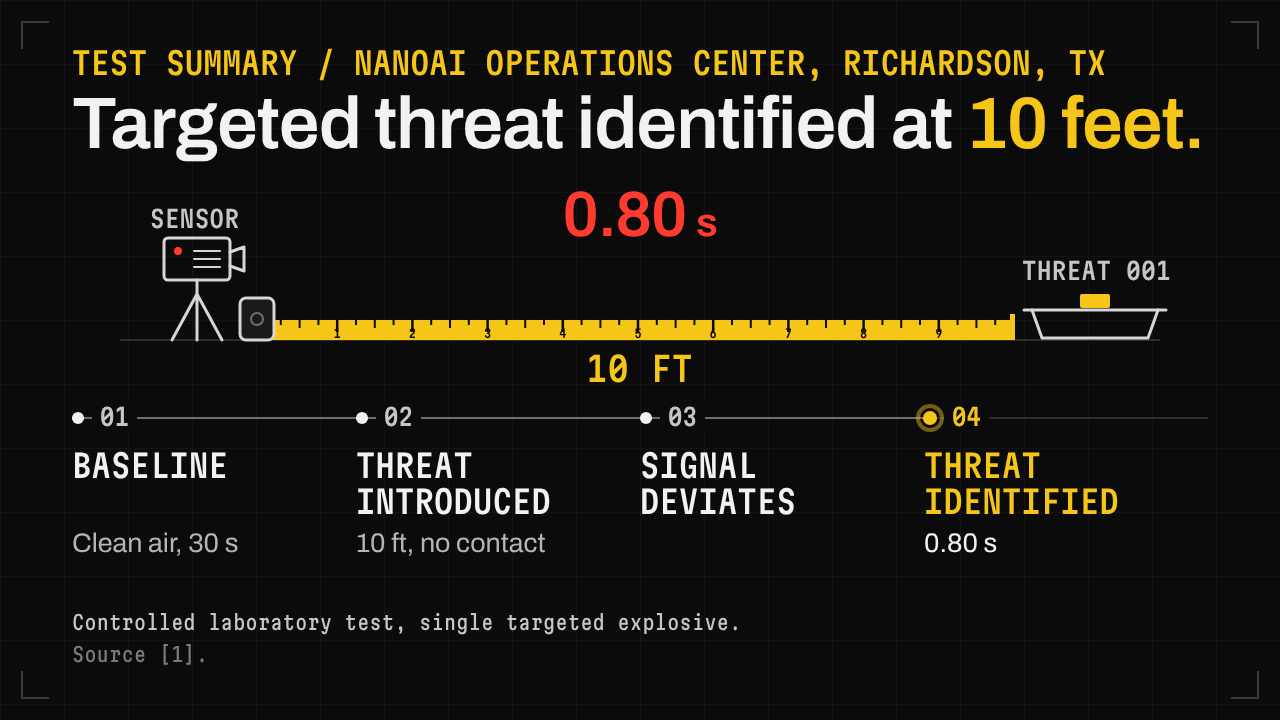
The device is blurred. That is normal in defense technology: keep the hardware close, show what it does. [1]
More than 60,000 validation tests
And independent validation in a peer-reviewed study published in Scientific Reports, a Nature Portfolio journal. [2] Now that process has met a targeted explosive, on camera.
Here is the way I see it.
Every field method for finding explosives has the same step. Get close enough to take a sample. Swab it. Hold the probe to it. Walk the dog up to it.
The chemistry after that is excellent. A leading portable trace detector analyses a swab in 8 to 12 seconds. [3] It is certified and deployed worldwide.
But the analysis is not the dangerous part. The sample is. That’s the step that puts a person in range.
NanoAi's test removes that step.
Most technology called disruptive makes each step faster. This one deletes it. That is why I think this result deserves more attention than a lab number usually gets.
Imagine this ability in everyday life
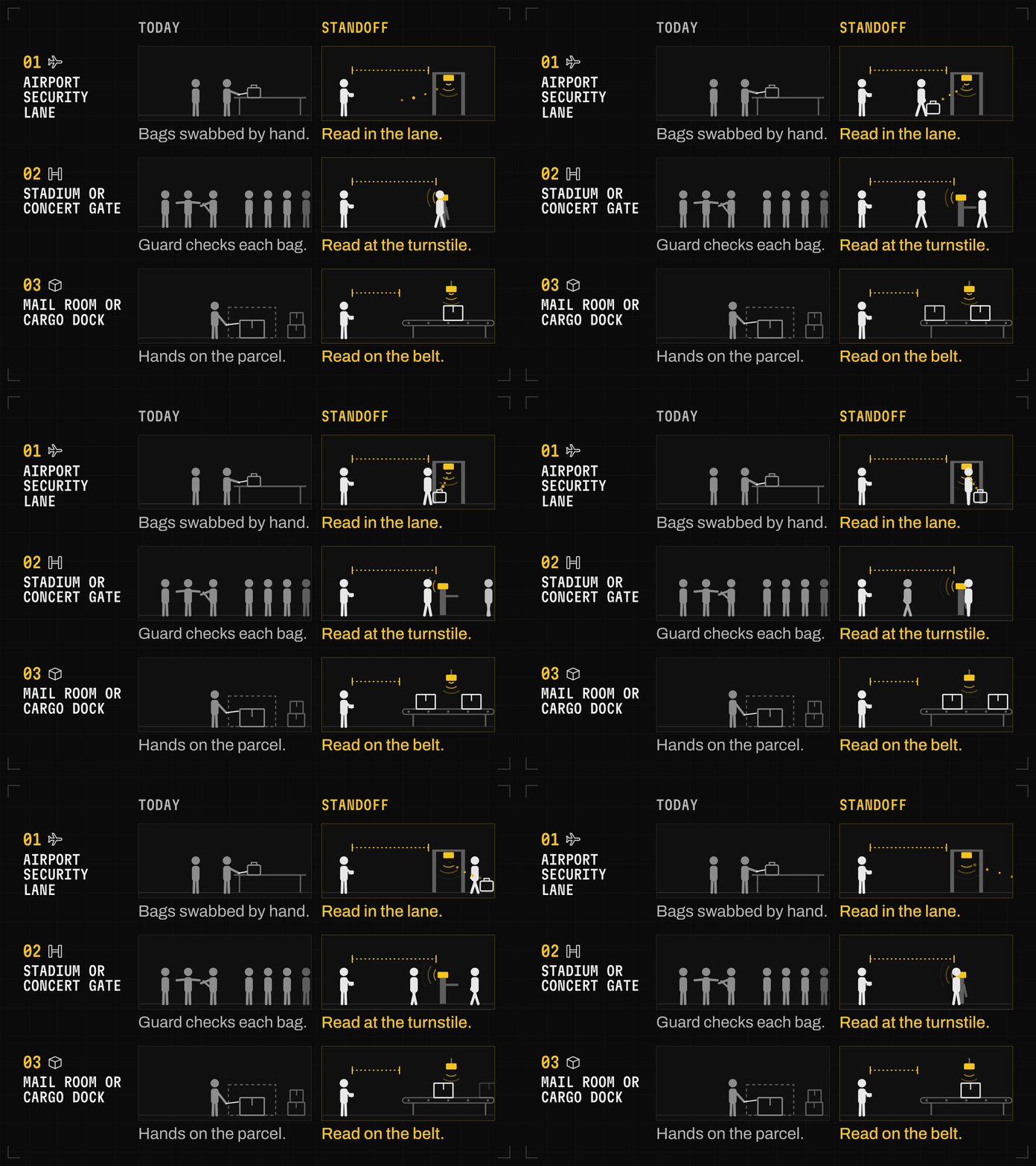
The platform is built for defense first, then law enforcement, border security and critical infrastructure. [1] Picture the reading from the video in the places explosives are screened for today.
None of that has happened yet. The test has. And the sensor is built for helmets, drones, robots, vehicles and fixed mounts. [1] That is every row on that card.
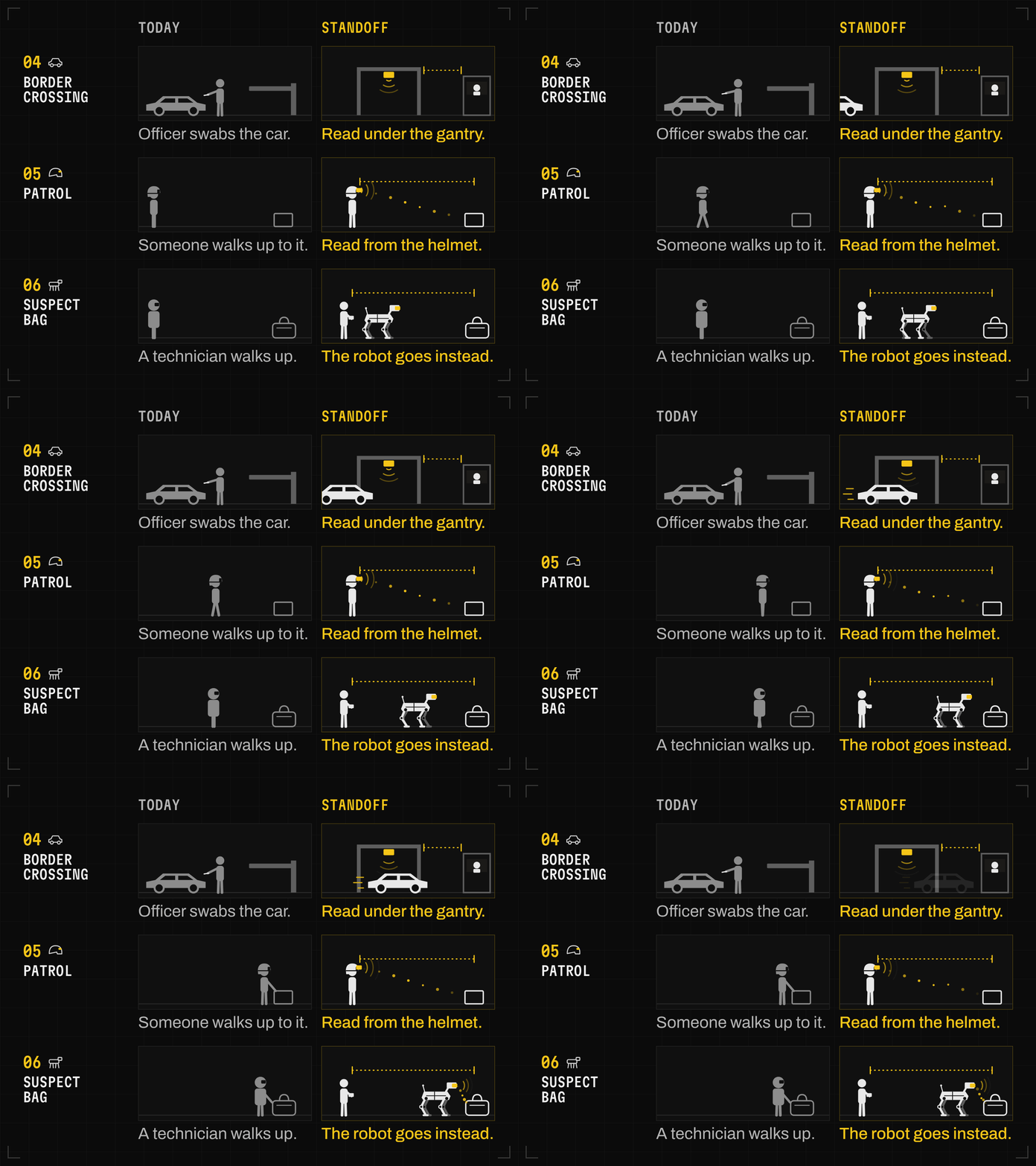
Illustrative. Applications on the platfor is built for, per Source [1]. Laboratory results; not deployed in any of these settings.
He used to be the one walking up
Craig Micklich spent 12 years as a U.S. Navy SEAL before he founded NanoAi.
He has described the problem the same way every time we have asked him.
"In many situations, the only way to confirm a threat was to walk up to it." [7]
And the purpose of the company in one sentence:
"NanoAi is being built to remove that requirement." [8]
That is why there is a tape measure in the video. When testing began, Craig said the objective was to take the platform to the targeted explosive to validate the accuracy of the hardware and software. When the result came in, he said this:
"This test shows the sensor reading the air, registering the threat and alerting the operator in under a second, at standoff. We recorded it so people can see it for themselves." [1]
I have worked with a lot of founders. The ones who have personally stood where their product is meant to stand describe it differently. Craig does not talk about the sensor as a product category. He talks about the stand off distance.
Machines go in first now. They cannot smell.
This result arrived in a particular month. The month matters.
On September 30 the U.S. Department of Defense announced a four-star command for autonomous warfare. It asked for roughly 240 times more money for it in fiscal 2027 than in 2026. [7] Jason covered the numbers on his last blog here .
The direction is plain. Drones and robots go in ahead of people.
Every one of those machines is limited by what it can sense. Cameras see. Microphones hear. Nothing on a standard drone or robot can detect an explosive it cannot see. If machines go first, they need a nose.
The money is committed for a decade.
World military spending hit US$2.89 trillion in 2025, its eleventh straight rise. [5]
Every NATO ally has signed up to 5% of GDP by 2035. [6]
The detection industry's own analysts name non-contact sampling as the next generation development. [4]
None of that is a NanoAi contract. It is the weather. It is the weather this sensor was built for, and it arrived the same month the sensor detected its first explosive on camera.
What I think this means
The hard question was never whether this could be mounted, networked or sold. It was whether a sensor could read an explosive out of the air, at standoff, fast enough to matter and the results have proved this.
The situations it is built for are the ones where getting close is the risk. The patrol. The cordon. The vehicle at the gate. The package nobody wants to touch. Taking the walk-up out of those situations is not an improvement. For the person who would have been walking, it is everything.
That is why NanoAi has not waited. It has taken physical possession of Gentex Corporation's full Ops-Core RAILINK rail system and started hands-on work to integrate its sensor, with Gentex's engineering team involved. [1][4] Gentex's Ops-Core helmets are worn by U.S. and allied forces. Gentex has supplied U.S. Special Operations Command since 1987. [1]
The aim is to put the sensor that detected Threat 001 onto the rail that goes on those helmets. [1][4]
That is what tangible looks like in this industry. Not a slide. The incumbent's hardware, in NanoAi's hands, with the incumbent's engineers involved.
Today: Threat 001 has been detected. Nobody walked up to it. The next tests go to more threats, and to the helmet, drone, robot and vehicle the sensor was built for.
Disclaimer
Intellistake has entered into a definitive agreement to acquire NanoAi and Intellistake has entered into a definitive agreement to acquire NanoAi and Completion of the NanoAi transaction remains subject to customary conditions including completion of satisfactory due diligence (including verifying title to the intellectual property of NanoAi), completion of the audit of financial statements of NanoAi, the Company maintaining a minimum cash balance of $2 million and no objection from the Canadian Securities Exchange. Closing is subject to satisfaction of closing conditions in the definitive agreement.
This report contains "forward-looking information" concerning anticipated developments and events related to the Company that may occur in the future. Forward looking information contained in this report includes, but is not limited to, all statements in respect of the Company's growth and development, expectations regarding market growth, the operations and business segments of the Company and NanoAi, the functionality of the Company’s technology, and its benefits, the details of the proposed acquisition of NanoAi, the conditions to completion of the proposed acquisition of NanoAi, the benefits of the acquisition of NanoAi, the business model of NanoAi, the applications of the NanoAi technology, the synergies between NanoAi and the Company, and bridging the gap between emerging decentralized networks and real-world industry adoption.
In certain cases, forward-looking information can be identified by the use of words such as "expects", "intends", "anticipates" or variations of such words and phrases or state that certain actions, events or results "may", "would", or "might" suggesting future outcomes, or other expectations, assumptions, intentions or statements about future events or performance. Forward-looking information contained in this report is based on certain assumptions regarding, among other things, the Company will continue to have access to financing until it achieves profitability; the Company and NanoAi satisfy all conditions necessary to close the proposed transaction; the technology and blockchain industries in which the Company intends to focus its business in will grow at the rate and in the manner expected; the ability to attract qualified personnel; the success of market initiatives and the ability to grow brand awareness; the ability to distribute Company's services; the Company creates strategies to mitigate risks associated with cryptocurrency price fluctuations; the Company remains compliant with all applicable laws and securities regulations and applicable licensing requirements; the Company engages and collaborates with local experts, as necessary, to address jurisdiction-specific matters and ensures compliance with foreign regulations to avoid penalties; the Company addresses any potential cybersecurity threats promptly and effectively; the ability of the Company to develop its technology, acquire customers and have revenue; the ability to successfully deploy the new business strategy as a result of the change of business. While the Company considers these assumptions to be reasonable, they may be incorrect.
Forward looking information involves known and unknown risks, uncertainties and other factors which may cause the actual results to be materially different from any future results expressed by the forward-looking information. Such factors include risks related to general business, economic and social uncertainties; failure of the Company and NanoAi to satisfy all conditions necessary to close the proposed transaction; failure to raise the capital necessary to fund its operations; inability to create strategies to mitigate the risks associated with cryptocurrency price fluctuations; the costs of regulation in the digital asset industries increase to the extent that the Company is no longer generating sufficient returns for shareholders; failure to promptly and effectively address cybersecurity threats; insufficient resources to maintain its operations on a competitive basis; and the actual costs, timing and future plans differs expectations; legislative, environmental and other judicial, regulatory, political and competitive developments; the inherent risks involved in the cryptocurrency and general securities markets; the Company may not be able to profitably liquidate its current digital currency inventory, or at all; a decline in digital currency prices may have a significant negative impact on the Company's operations; the Company's success may depend on the continued involvement of key personnel, including advisors, whose involvement cannot be guaranteed; institutional adoption of decentralized AI infrastructure remains uncertain and may not occur at the pace or scale anticipated; evolving regulatory frameworks, including those related to AI (such as Canada's proposed Artificial Intelligence and Data Act) and prediction markets, may impose additional compliance burdens or restrict certain business activities; valuation figures are based on publicly available market data and internal assessments at the time of the referenced transactions and may not reflect current or future valuations; the volatility of digital currency prices; the inherent uncertainty of cost estimates and the potential for unexpected costs and expenses, currency fluctuations; regulatory restrictions, liability, competition, loss of key employees and other related risks and uncertainties; delay or failure to receive regulatory approvals; failure to attract qualified personnel, labour disputes; and the additional risks identified in the "Risk Factors" section of the Company's filings with applicable Canadian securities regulators.
Although the Company has attempted to identify factors that could cause actual results to differ materially from those described in forward-looking information, there may be other factors that cause results not to be as anticipated. Readers should not place undue reliance on forward-looking information. The forward-looking information is made as of the date of this report. Except as required by applicable securities laws, the Company does not undertake any obligation to publicly update forward-looking information.