
Your Phone Gets Smarter While You Sleep. So Why Can't the Gear That Keeps People Alive?
This Post is disseminated on behalf of Intellistake Technologies Corp.
Think about the last time your phone updated itself.
You probably didn't even notice. You plugged it in, went to bed, and woke up to something a little better than the thing you put down. A new feature. A fix. A camera that suddenly handles low light better. Same phone. Nothing new arrived in the mail.
We've all gotten so used to that, we don't think about it anymore. You buy the hardware once, and it keeps getting smarter.
Now think about the equipment people rely on when the stakes are a lot higher than a blurry photo.
A lot of it doesn't work that way. Detection equipment is generally set up to find what it was configured for on the day it was issued . When the threat changes, the answer has often been new equipment, a new buying cycle, or someone getting closer to a suspicious object than anyone should ever have to.
That's the part I can't stop thinking about...
What happened this week
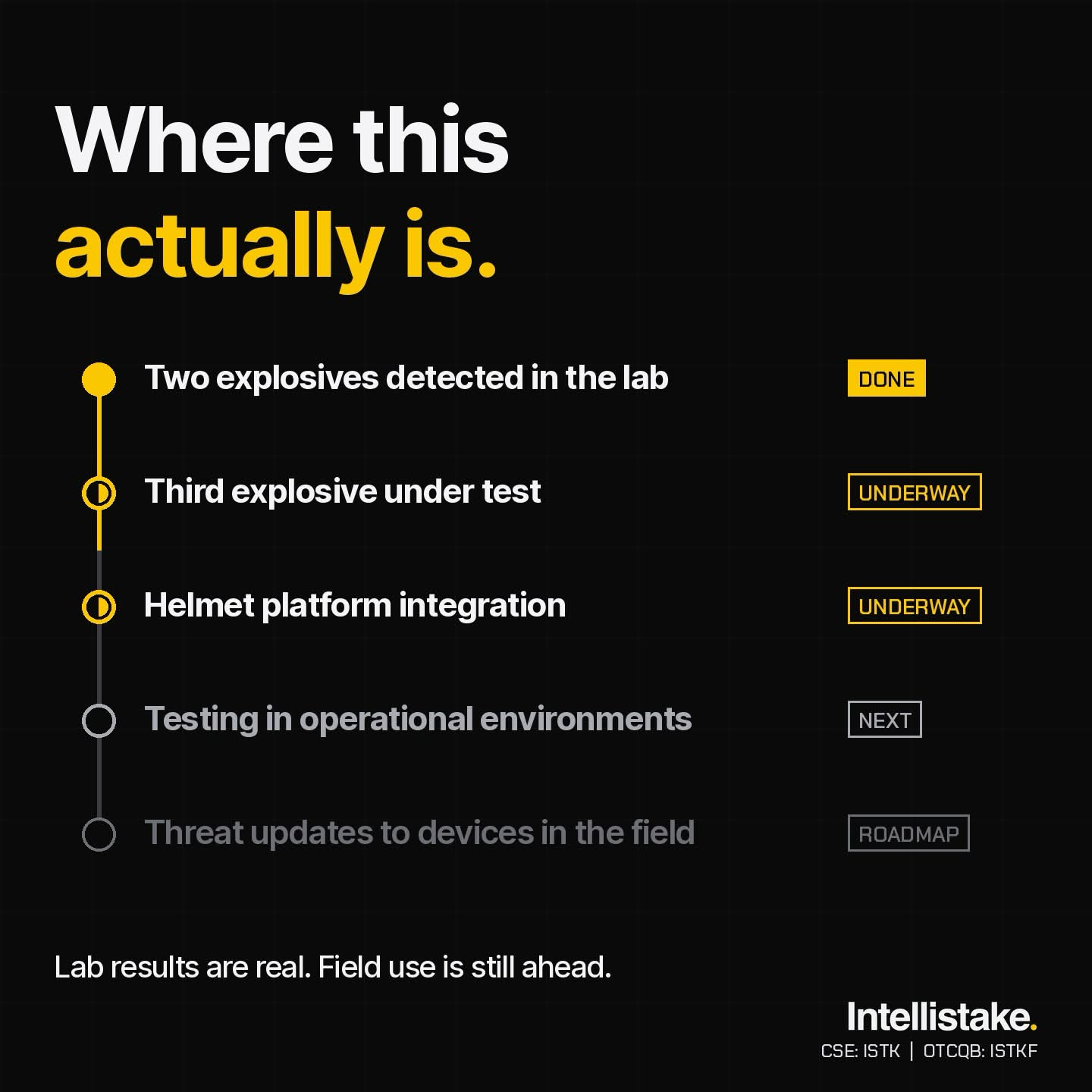
On October 29, we announced that NanoAi, the company we've agreed to acquire, completed planned laboratory testing on a second explosive, called Threat 002. Same sensor as Threat 001. No hardware changes . Detected at standoff, without physical contact.
A bit of context. A week earlier, we reported that NanoAi had passed more than 2,000 successful standoff tests on Threat 001, including one on camera where the sensor flagged it in under a second. And a third explosive is already being tested.
I want to be straight with you here. Two explosives in a lab is not the finished product. Nothing is deployed in the field yet. But what this does show is something that matters a lot: the same piece of hardware can recognize more than one threat type.
Why that one detail matters so much
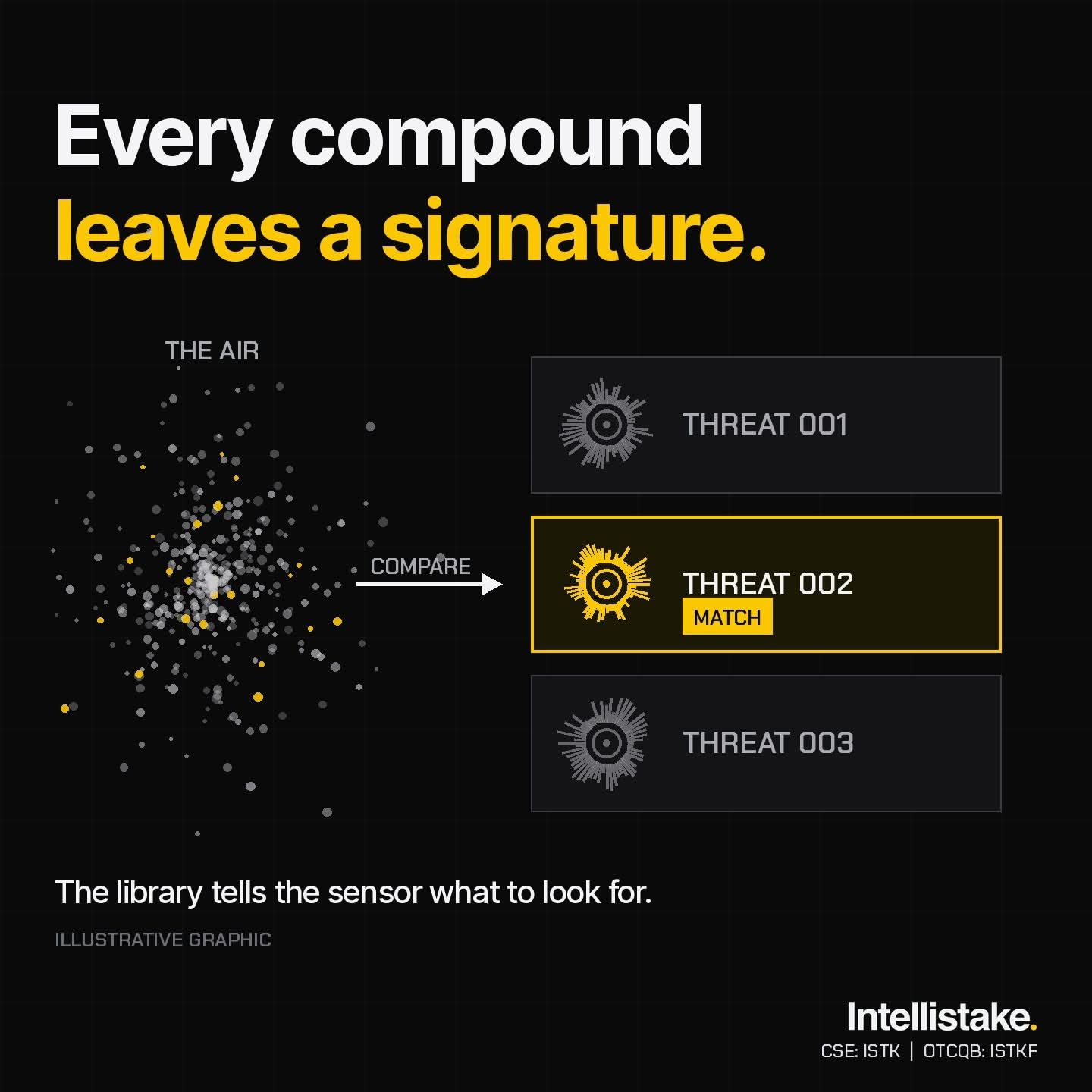
NanoAi is building what it calls a threat fingerprint library. Every compound it tests and validates becomes a signature the sensor can be set up to recognize. Threat 001 was the first entry. Threat 002 is the second. Threat 003 is underway.
Here's where your phone comes back in.
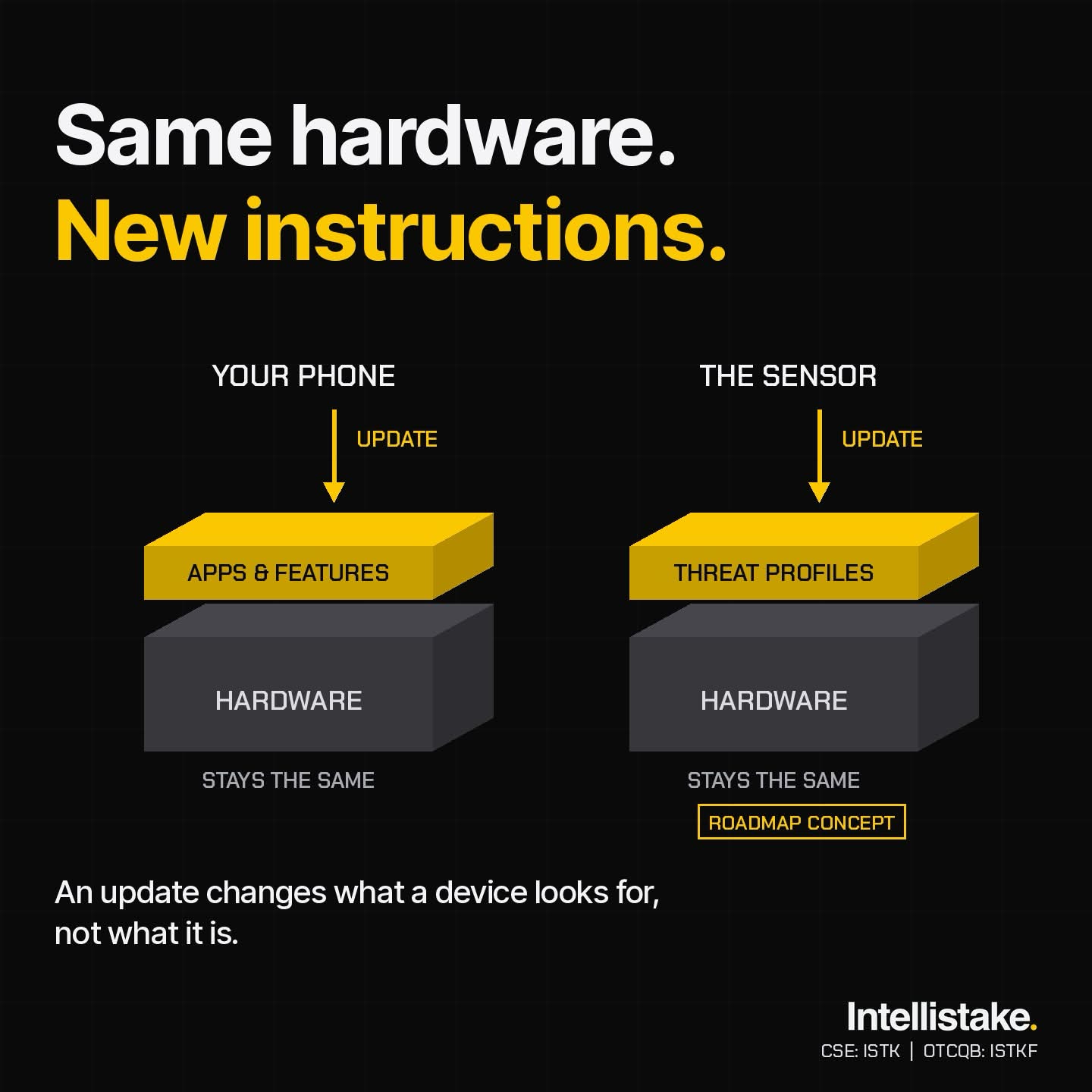
If the same sensor can be configured to recognize what's in the library, then what it looks for isn't fixed by the hardware. It's defined by the library. And libraries grow.
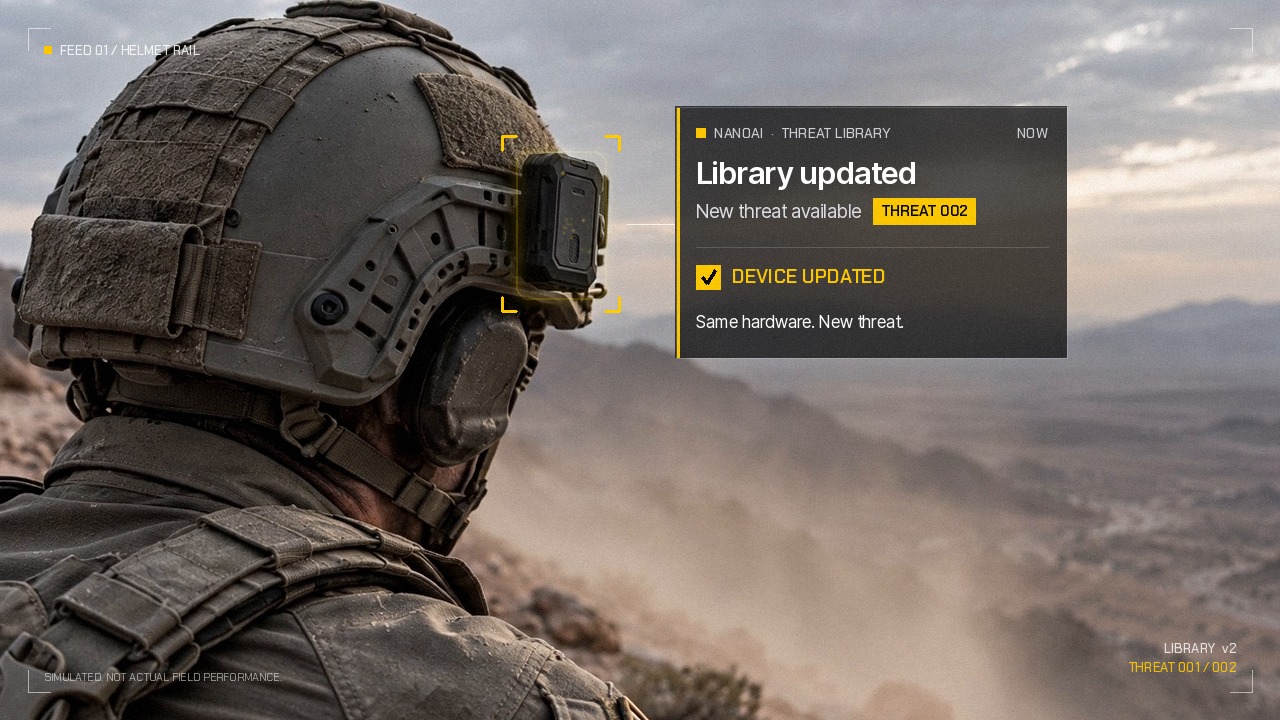
So picture this. Someone is wearing a sensor set up to look for one explosive. New intelligence says a different threat is now the concern, one that's already in the library. Instead of pulling them off the job to swap their kit, an authorized update goes out through the cloud, and the sensor they're already wearing starts looking for the new threat. Maybe instead of the old one. Maybe alongside it.
That's the roadmap. You can see why it gets me excited. A new threat becomes a new signature, not a new device.
How Intellistake Could Turn NanoAi's Sensor Technology Into a Scalable Software Platform
People ask me why a software and AI company wants to buy a sensor company. This is the answer.
NanoAi builds the sensor and does the hard science of identifying threats in the lab. What makes that sensor more valuable over time is everything around it: organizing and maintaining the library, controlling which detection profiles are authorized, and getting validated updates securely onto the right devices. That's software and data infrastructure. That's what we want to build.
It also changes the relationship with whoever uses the equipment. A lot of hardware is a moment. You buy it, it does what it does, and one day you replace it. A sensor that keeps getting new capabilities is a relationship. It can keep becoming more useful long after the day it was issued, and over time that could open the door to things like licensing and update services.
Your phone taught all of us to expect that. I don't see why the people with the most dangerous jobs should get less.
What I'm watching next
Threat 003. Then the one after that. Every validated fingerprint grows the library, and every addition is another reason the same sensor could be worth more tomorrow than it is today.
Alongside that, NanoAi has started hands-on development with Gentex's full Ops-Core RAILINK system, and our proposed acquisition still has closing conditions to work through. I'll keep sharing as things move.
If you want to see where this started, watch the first on-camera test of Threat 001. It's short, and it's worth it.
Thank you for reading. I mean that.
Jason
Disclaimer
Intellistake has entered into a definitive agreement to acquire NanoAi and Intellistake has entered into a definitive agreement to acquire NanoAi and Completion of the NanoAi transaction remains subject to customary conditions including completion of satisfactory due diligence (including verifying title to the intellectual property of NanoAi), completion of the audit of financial statements of NanoAi, the Company maintaining a minimum cash balance of $2 million and no objection from the Canadian Securities Exchange. Closing is subject to satisfaction of closing conditions in the definitive agreement.
This report contains "forward-looking information" concerning anticipated developments and events related to the Company that may occur in the future. Forward looking information contained in this report includes, but is not limited to, all statements in respect of the Company's growth and development, expectations regarding market growth, the operations and business segments of the Company and NanoAi, the functionality of the Company’s technology, and its benefits, the details of the proposed acquisition of NanoAi, the conditions to completion of the proposed acquisition of NanoAi, the benefits of the acquisition of NanoAi, the business model of NanoAi, the applications of the NanoAi technology, the synergies between NanoAi and the Company, and bridging the gap between emerging decentralized networks and real-world industry adoption.
In certain cases, forward-looking information can be identified by the use of words such as "expects", "intends", "anticipates" or variations of such words and phrases or state that certain actions, events or results "may", "would", or "might" suggesting future outcomes, or other expectations, assumptions, intentions or statements about future events or performance. Forward-looking information contained in this report is based on certain assumptions regarding, among other things, the Company will continue to have access to financing until it achieves profitability; the Company and NanoAi satisfy all conditions necessary to close the proposed transaction; the technology and blockchain industries in which the Company intends to focus its business in will grow at the rate and in the manner expected; the ability to attract qualified personnel; the success of market initiatives and the ability to grow brand awareness; the ability to distribute Company's services; the Company creates strategies to mitigate risks associated with cryptocurrency price fluctuations; the Company remains compliant with all applicable laws and securities regulations and applicable licensing requirements; the Company engages and collaborates with local experts, as necessary, to address jurisdiction-specific matters and ensures compliance with foreign regulations to avoid penalties; the Company addresses any potential cybersecurity threats promptly and effectively; the ability of the Company to develop its technology, acquire customers and have revenue; the ability to successfully deploy the new business strategy as a result of the change of business. While the Company considers these assumptions to be reasonable, they may be incorrect.
Forward looking information involves known and unknown risks, uncertainties and other factors which may cause the actual results to be materially different from any future results expressed by the forward-looking information. Such factors include risks related to general business, economic and social uncertainties; failure of the Company and NanoAi to satisfy all conditions necessary to close the proposed transaction; failure to raise the capital necessary to fund its operations; inability to create strategies to mitigate the risks associated with cryptocurrency price fluctuations; the costs of regulation in the digital asset industries increase to the extent that the Company is no longer generating sufficient returns for shareholders; failure to promptly and effectively address cybersecurity threats; insufficient resources to maintain its operations on a competitive basis; and the actual costs, timing and future plans differs expectations; legislative, environmental and other judicial, regulatory, political and competitive developments; the inherent risks involved in the cryptocurrency and general securities markets; the Company may not be able to profitably liquidate its current digital currency inventory, or at all; a decline in digital currency prices may have a significant negative impact on the Company's operations; the Company's success may depend on the continued involvement of key personnel, including advisors, whose involvement cannot be guaranteed; institutional adoption of decentralized AI infrastructure remains uncertain and may not occur at the pace or scale anticipated; evolving regulatory frameworks, including those related to AI (such as Canada's proposed Artificial Intelligence and Data Act) and prediction markets, may impose additional compliance burdens or restrict certain business activities; valuation figures are based on publicly available market data and internal assessments at the time of the referenced transactions and may not reflect current or future valuations; the volatility of digital currency prices; the inherent uncertainty of cost estimates and the potential for unexpected costs and expenses, currency fluctuations; regulatory restrictions, liability, competition, loss of key employees and other related risks and uncertainties; delay or failure to receive regulatory approvals; failure to attract qualified personnel, labour disputes; and the additional risks identified in the "Risk Factors" section of the Company's filings with applicable Canadian securities regulators.
Although the Company has attempted to identify factors that could cause actual results to differ materially from those described in forward-looking information, there may be other factors that cause results not to be as anticipated. Readers should not place undue reliance on forward-looking information. The forward-looking information is made as of the date of this report. Except as required by applicable securities laws, the Company does not undertake any obligation to publicly update forward-looking information.