
It Was Built to Check Car Exhausts. Now It’s Finding Explosive Material Without Anyone Getting Close.
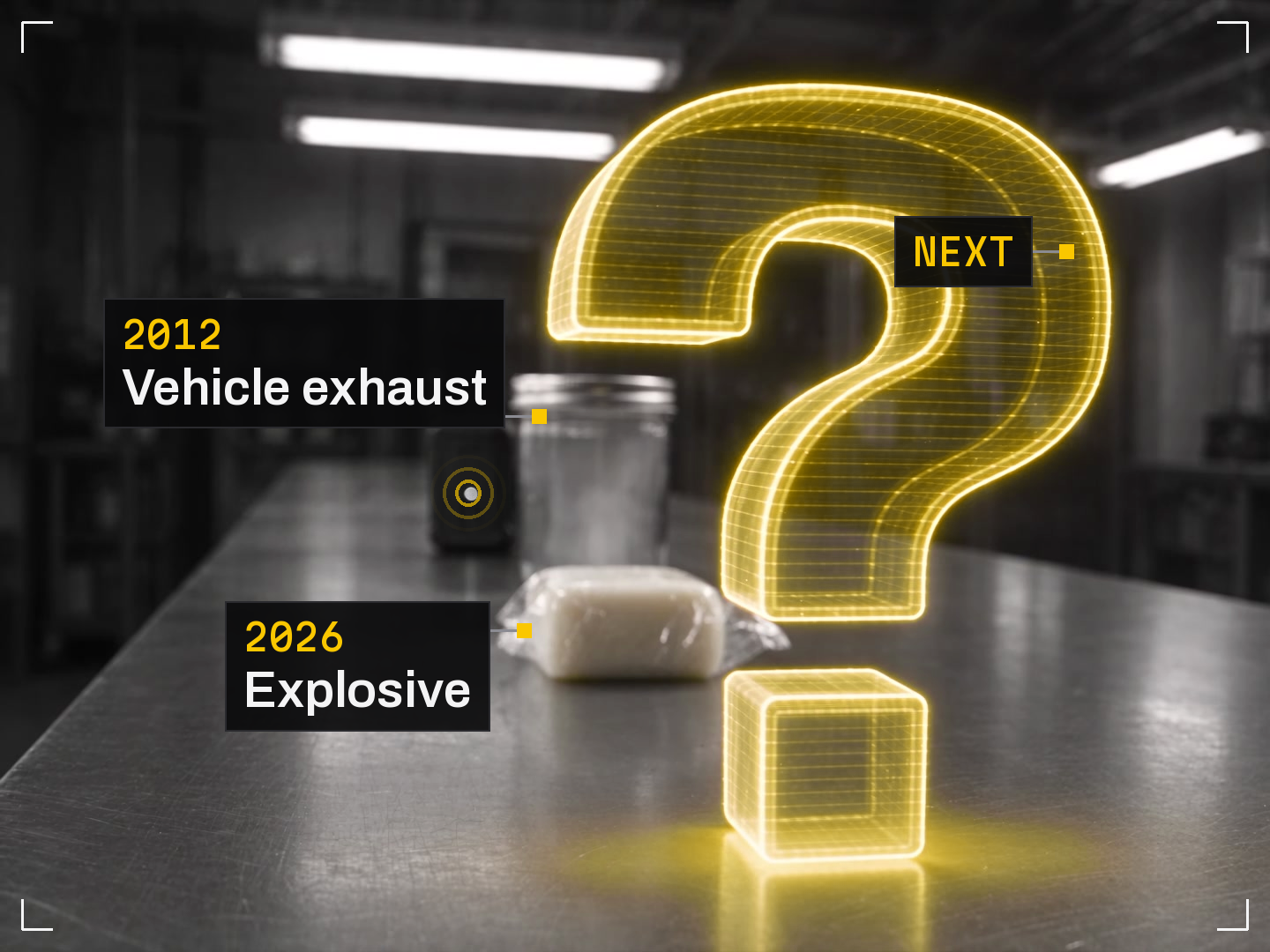
This Post is disseminated on behalf of Intellistake Technologies Corp.
If you have ever taken a car in for an emissions test, you have watched a sensor do a very ordinary job. It measures what comes out of the exhaust pipe, prints a result, and you drive home.
Nobody leaves that garage thinking about the soldier clearing a road, the officer at a checkpoint or the person sent toward a bag nobody wants to open.
But that is where NanoAi’s story started. Not in a defense lab. In a project to measure car exhausts.
People ask me how a technology like this comes about. The honest answer is that this is not really my story. It belongs to Craig Micklich, NanoAi’s founder. What follows is the story as Craig has told it to me, alongside the public evidence behind it.
It took more than a decade, two very different worlds, and one person willing to ask a question nobody else had asked. Here is how it happened.
2012: Texas Instruments set out to measure car exhaust and took on one of the hardest problems in gas sensing
In 2012, Texas Instruments began working with the University of Texas at Dallas on a sensor to detect vehicle emissions, mainly carbon dioxide.
The research went after one of the oldest headaches in gas sensing: keeping a reading accurate while the temperature swings from extreme heat to extreme cold.
That sounds technical, so think about your phone on a freezing winter day, or a car that will not start in a cold snap. Electronics are fussy about temperature, and gas sensors are worse. Heat and cold throw off sensitivity, accuracy and reliability. It has long been one of the hardest problems in the field.
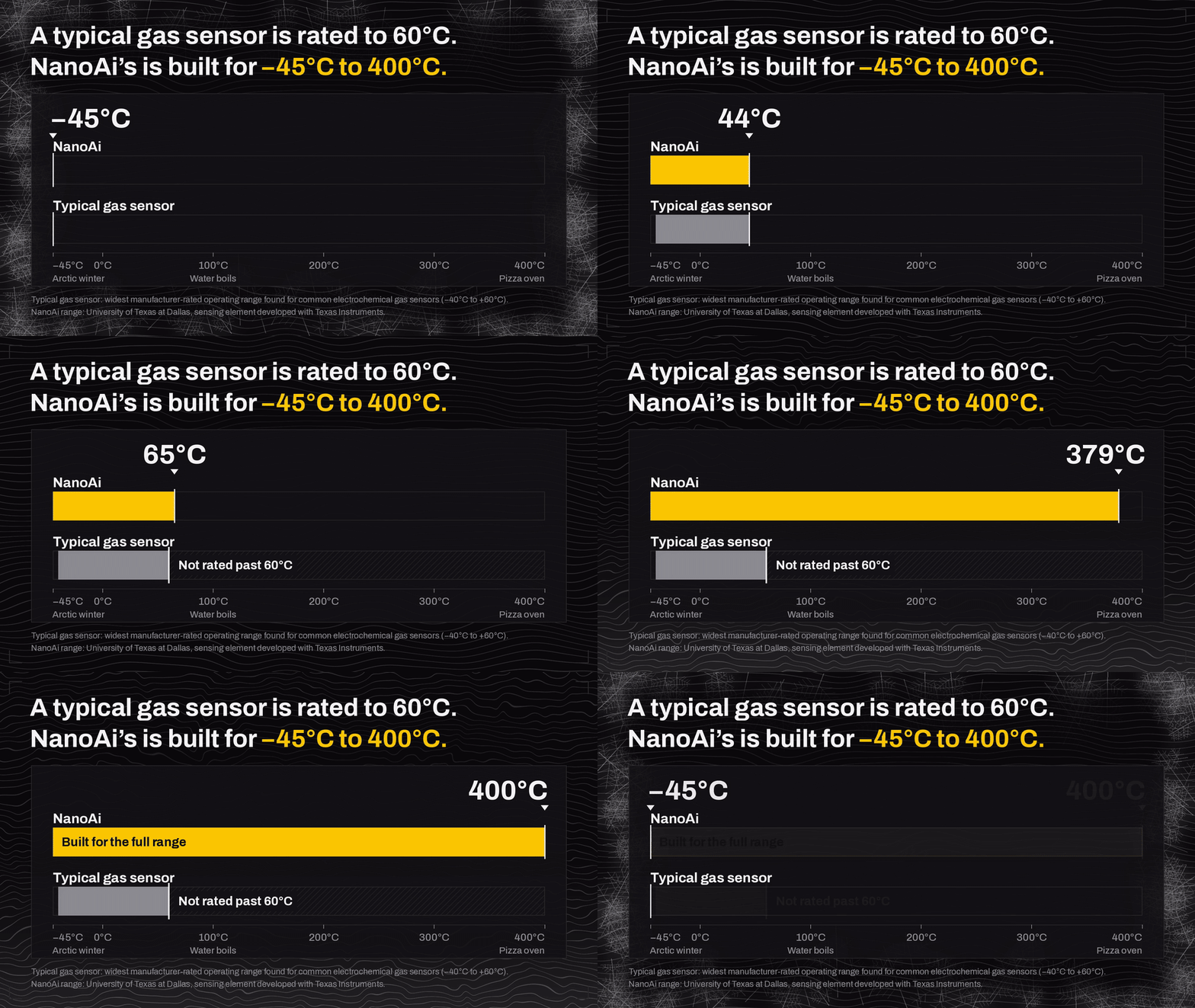
UT Dallas later described the work publicly: a sensing element developed with scientists at Texas Instruments and engineered to withstand temperatures from minus 45 to 400 degrees Celsius.
Nobody in 2012 was thinking about explosives. It was a car project.
2016: a breakthrough with nobody to carry it the rest of the way
By 2016, the technology was moving toward commercialization. Then Texas Instruments shifted its priorities back to its core semiconductor business and stepped away. The technology went back to the university.
And there it sat.
I have seen this pattern many times in my career in public markets. A brilliant idea is not a business. University labs are built to discover things and publish what they find. Turning a working bench experiment into a product someone can actually use is a completely different job, and it needs a different kind of person.
The numbers bear that out. In 2023 alone, U.S. universities and research institutions reported more than 25,000 new invention disclosures, according to AUTM , the association for university technology transfer. That same year, 714 new commercial products came out of academic research.
For about two years, this one did not have that person.
A brilliant idea is not a business. Somebody has to carry it the rest of the way.
October 2018: a former Navy SEAL walked into the lab looking for something else entirely
Craig Micklich spent 12 years as a U.S. Navy SEAL before moving into finance, with senior roles at Deutsche Bank and Morgan Stanley. In 2018 he was looking for technology that could help veterans living with post-traumatic stress disorder.
That search took him to a research lab at UT Dallas that was exploring whether stress could be detected in a person’s breath. The sensor was not the reason he went. But while he was there, a piece of equipment caught his eye, and he asked what it was.
He was told it came from the old Texas Instruments project. It had been built to detect carbon dioxide in car exhaust.
Most people would have nodded and moved on. Craig started asking questions.
Was it limited to carbon dioxide? No. The underlying platform could potentially detect a broad range of compounds.
Could it detect explosives? Potentially, yes.
Narcotics? Potentially, yes.
And then the question that changed everything. Did it need to touch the thing it was detecting, the way a swab at the airport does?
No. The technology had the potential to detect its target without physical contact.
Did it need to touch anything? No. That visit was the genesis of NanoAi.
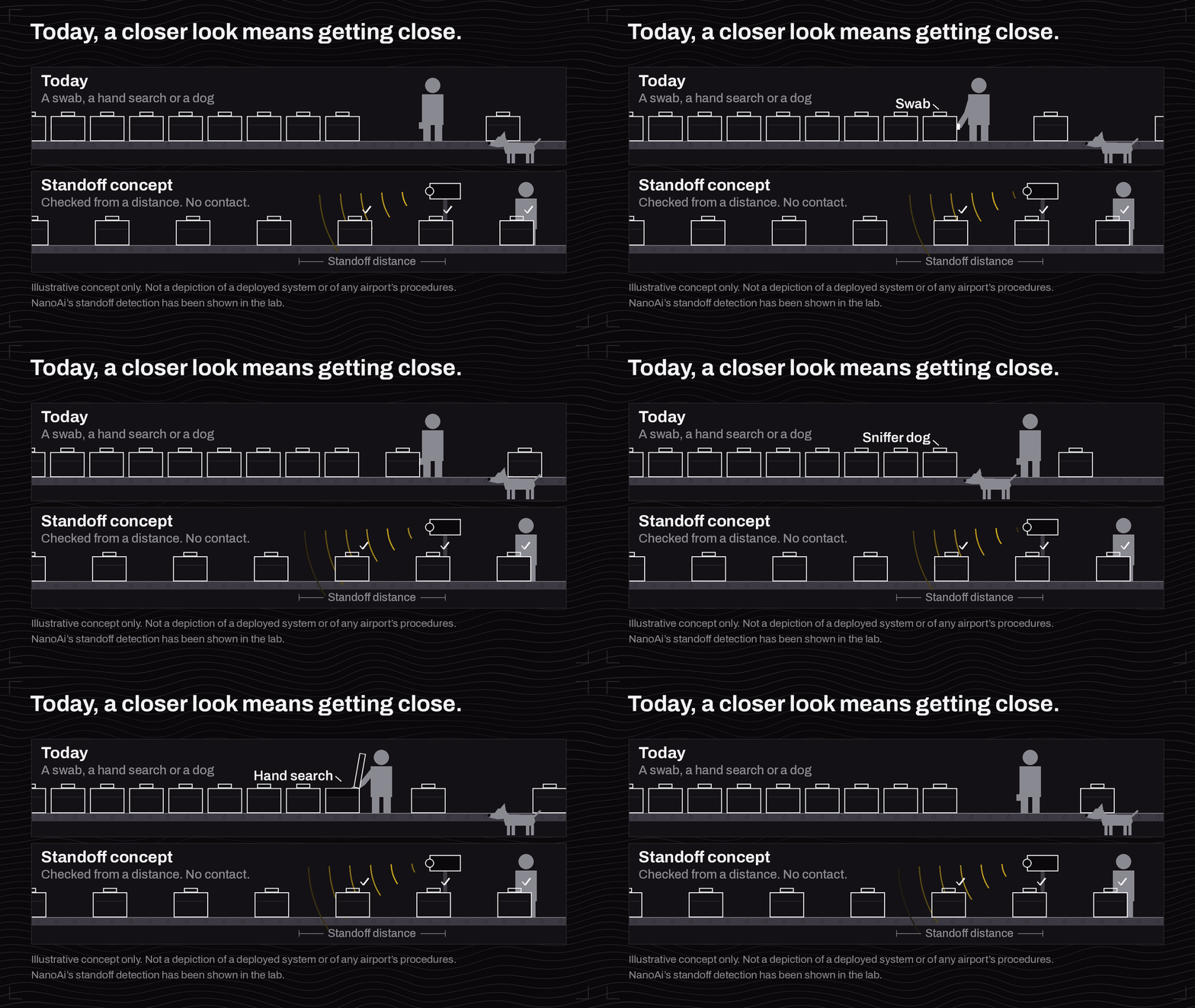
Think about why that answer matters. Almost every security check you have ever been through needed someone to get close. Someone wipes your hands, opens the bag, walks up to the parcel. The most familiar thing that can check for a threat without touching it is a trained detection dog. Craig had found a technology with the potential to check for a threat without anyone getting close at all.
To put the scale of that in perspective, TSA screened 2.1 billion carry-on bags in 2025 alone, according to its own testimony to Congress this January. That is nearly 5.8 million bags a day, in the United States alone. And when a bag needs a closer look, the check usually still means a swab, a hand search or a dog.
January 2019: one team, no lanes, and nine months from lab experiment to working prototype
Three months after that visit, Craig had raised initial funding and hired a small team: mechanical, electrical, hardware and software engineers, many of them from defence industry backgrounds.
When they asked what their individual responsibilities would be, Craig told them there were no predetermined lanes. Their job was to solve the problem together and build something that worked.
If you have ever worked somewhere where every job lives in its own box, you will know how unusual that is. In a lot of large organisations, an engineer owns one narrow piece and hands it on. Craig wanted the opposite: every discipline at the same table, on the same problem, at the same time.
They worked around the clock. Within about nine months, they had taken a university lab experiment and turned it into a working prototype.
January 2019: a lab experiment. Late 2019: a working prototype.
2020 to 2022: the science goes up for independent scrutiny
Building a prototype is one thing. Having strangers check your work is another.
In 2020, the core detection process went into a clinical study at Cleveland Clinic Abu Dhabi, alongside the University of Texas at Dallas.
The study evaluated whether a portable breath analyser could screen for COVID-19 by detecting specific trace compounds in exhaled breath.
In March 2022, the results were published in Scientific Reports, part of the Nature Portfolio, after independent peer review.
Coming from markets, that is the moment I care about. It is when a story becomes evidence. Scientists with no stake in the outcome looked at the method and the data, and the work stood up.
Not one detector. One platform. Why that distinction is the part I care about most.
This is where Craig’s thinking set NanoAi apart, and it is the part that matters most to me.
He could have built one detector, for one threat, for one customer, and called it a company. He did not. From the beginning, he saw that what he had found was not a single product. It was a foundational sensing technology that could support many products, across many industries.
The list of places a sensor like this is designed to matter is long: defence, law enforcement, border security, critical infrastructure and healthcare.
A product does one job. A platform keeps finding new ones.
The question Craig asked in 2018, “is it limited to carbon dioxide?”, is the same question NanoAi is still answering today. Every new threat it learns to read is another answer.
Fourteen years, one idea: how a car project became a sensing platform
Step back from the dates, and the shape of this story is simple.
It began in 2012 as a Texas Instruments-sponsored research project to measure carbon dioxide in vehicle emissions. From there it moved through university research, into independent commercialization, through a multidisciplinary engineering build, and into the company NanoAi is today.
What started as an effort to detect carbon dioxide in cars became the foundation for a platform with potential applications in explosives detection, narcotics identification, healthcare and industrial settings.
What began as a way to measure car exhaust became the foundation for a platform.
In my view, the defining achievement was not a single discovery. Plenty of good science stays on the bench. It was recognising how much more that original research could do, and then bringing together the science, the engineers, the funding and the commercial vision to turn it into a practical sensing platform.
That is what turns research into a company, and it is the part I find most compelling.
Since then, the core science has passed independent peer review, and this October the platform detected two different explosives at standoff in the lab, on the same hardware. You can check out this video from the lab: https://www.youtube.com/watch?v=vIJezZGDUYQ
From the emissions test to the person who has to go first
Every car emissions test is a sensor doing a very ordinary job. Fourteen years ago, a version of that idea started down a very different road.
Now it is being built for the people we send toward the bag, the parcel and the door, so they can find out what is there before they get there.
Know before contact.
Jason
Disclaimer
Intellistake has entered into a definitive agreement to acquire NanoAi and Intellistake has entered into a definitive agreement to acquire NanoAi and Completion of the NanoAi transaction remains subject to customary conditions including completion of satisfactory due diligence (including verifying title to the intellectual property of NanoAi), completion of the audit of financial statements of NanoAi, the Company maintaining a minimum cash balance of $2 million and no objection from the Canadian Securities Exchange. Closing is subject to satisfaction of closing conditions in the definitive agreement.
This report contains "forward-looking information" concerning anticipated developments and events related to the Company that may occur in the future. Forward looking information contained in this report includes, but is not limited to, all statements in respect of the Company's growth and development, expectations regarding market growth, the operations and business segments of the Company and NanoAi, the functionality of the Company’s technology, and its benefits, the details of the proposed acquisition of NanoAi, the conditions to completion of the proposed acquisition of NanoAi, the benefits of the acquisition of NanoAi, the business model of NanoAi, the applications of the NanoAi technology, the synergies between NanoAi and the Company, and bridging the gap between emerging decentralized networks and real-world industry adoption.
In certain cases, forward-looking information can be identified by the use of words such as "expects", "intends", "anticipates" or variations of such words and phrases or state that certain actions, events or results "may", "would", or "might" suggesting future outcomes, or other expectations, assumptions, intentions or statements about future events or performance. Forward-looking information contained in this report is based on certain assumptions regarding, among other things, the Company will continue to have access to financing until it achieves profitability; the Company and NanoAi satisfy all conditions necessary to close the proposed transaction; the technology and blockchain industries in which the Company intends to focus its business in will grow at the rate and in the manner expected; the ability to attract qualified personnel; the success of market initiatives and the ability to grow brand awareness; the ability to distribute Company's services; the Company creates strategies to mitigate risks associated with cryptocurrency price fluctuations; the Company remains compliant with all applicable laws and securities regulations and applicable licensing requirements; the Company engages and collaborates with local experts, as necessary, to address jurisdiction-specific matters and ensures compliance with foreign regulations to avoid penalties; the Company addresses any potential cybersecurity threats promptly and effectively; the ability of the Company to develop its technology, acquire customers and have revenue; the ability to successfully deploy the new business strategy as a result of the change of business. While the Company considers these assumptions to be reasonable, they may be incorrect.
Forward looking information involves known and unknown risks, uncertainties and other factors which may cause the actual results to be materially different from any future results expressed by the forward-looking information. Such factors include risks related to general business, economic and social uncertainties; failure of the Company and NanoAi to satisfy all conditions necessary to close the proposed transaction; failure to raise the capital necessary to fund its operations; inability to create strategies to mitigate the risks associated with cryptocurrency price fluctuations; the costs of regulation in the digital asset industries increase to the extent that the Company is no longer generating sufficient returns for shareholders; failure to promptly and effectively address cybersecurity threats; insufficient resources to maintain its operations on a competitive basis; and the actual costs, timing and future plans differs expectations; legislative, environmental and other judicial, regulatory, political and competitive developments; the inherent risks involved in the cryptocurrency and general securities markets; the Company may not be able to profitably liquidate its current digital currency inventory, or at all; a decline in digital currency prices may have a significant negative impact on the Company's operations; the Company's success may depend on the continued involvement of key personnel, including advisors, whose involvement cannot be guaranteed; institutional adoption of decentralized AI infrastructure remains uncertain and may not occur at the pace or scale anticipated; evolving regulatory frameworks, including those related to AI (such as Canada's proposed Artificial Intelligence and Data Act) and prediction markets, may impose additional compliance burdens or restrict certain business activities; valuation figures are based on publicly available market data and internal assessments at the time of the referenced transactions and may not reflect current or future valuations; the volatility of digital currency prices; the inherent uncertainty of cost estimates and the potential for unexpected costs and expenses, currency fluctuations; regulatory restrictions, liability, competition, loss of key employees and other related risks and uncertainties; delay or failure to receive regulatory approvals; failure to attract qualified personnel, labour disputes; and the additional risks identified in the "Risk Factors" section of the Company's filings with applicable Canadian securities regulators.
Although the Company has attempted to identify factors that could cause actual results to differ materially from those described in forward-looking information, there may be other factors that cause results not to be as anticipated. Readers should not place undue reliance on forward-looking information. The forward-looking information is made as of the date of this report. Except as required by applicable securities laws, the Company does not undertake any obligation to publicly update forward-looking information.